At WeTreatFeet Podiatry, patients often ask us about exercise, especially using certain equipment like Treadmill or elliptical. As a result, we are going to discuss our thoughts on these machines. As always, make sure you discuss with your doctor before beginning an exercise regimen, and this does not constitute medical advice.

Professional Podiatry Care What We Wish Every Primary Care Physician Knew About Foot and Ankle Care
Here’s a 30‑minute, joint‑friendly treadmill walking workout that we provide to our patients at WeTreatFeet. This assumes patients have been cleared for exercise. You can scale speeds up or down based on the individual fitness and comfort level. This is the standard range below that are typical for most adults. However, if you have diabetes, neuropathy, balance issues, or a history of foot/ankle problems, start at the lower end of the speed ranges, use the rails as needed, and stop if experiencing pain. Pain is the bodies way of saying “hey dummy, stop!” If tingling, burning, or numbness in the feet or calves develops, call us or the PCP.
Protocol
Minutes 0–5: Easy warm‑up
Time: 0–2 minutes
Speed: 2.0–2.5 mph
Incline: 0%
Focus: Relax shoulders, light arm swing, just getting used to the belt moving.
Time: 2–5 minutes
Speed: 2.5–3.0 mph (comfortable but not lazy)
Incline: 0–1%
Focus: Start gentle heel‑to‑toe walking (see form section below). Breathe through your nose if you can; you should still be able to talk in full sentences.
Minutes 5–15: Brisk “steady” block
Time: 5–10 minutes
Speed: 3.0–3.5 mph
Incline: 1%
Effort: Feels like a purposeful walk—slightly out of breath, but you can still talk.
Time: 10–15 minutes
Speed: 3.2–3.8 mph (if you’re newer, stay closer to 3.0–3.2)
Incline: 1–2% if your joints tolerate it; 0% if you have knee, hip, or low‑back pain
Effort: Moderate. You should feel your calves and glutes doing some work, but no sharp pain, no “pinch” in the front of the ankle.
Minutes 15–25: Gentle intervals (change the incline, not speed)
Stay near the same walking speed; play with incline to wake up different muscle groups. This will mimic the “random hills” you get outside without pounding your joints.
Time: 15–17 minutes
Speed: 3.0–3.5 mph
Incline: 2%
Time: 17–19 minutes
Speed: 3.0–3.5 mph
Incline: 0–1% (flat recovery)
Time: 19–21 minutes
Speed: 3.0–3.5 mph
Incline: 3% (only if comfortable; otherwise repeat 2%)
Time: 21–23 minutes
Speed: 2.8–3.2 mph
Incline: Back down to 0–1%
Time: 23–25 minutes
Speed: 3.0–3.5 mph
Incline: 2%
Start with very small changes. In my experience, it’s usually the incline jumps that cause next‑day calf soreness in people with desk jobs.
Minutes 25–30: Cool‑down and foot‑friendly finish
Time: 25–28 minutes
Speed: 2.5–3.0 mph
Incline: 0%
Focus: Lengthen your stride slightly, easy heel‑to‑toe, loosen shoulders and hands (no death‑grip on the rails).
Time: 28–30 minutes
Speed: 2.0–2.5 mph
Incline: 0%
Focus: Shorter steps, relaxed breathing; start mentally checking in with your feet—any hot spots, rubbing, or numb toes? That’s exactly what I ask about in clinic after people start new walking routines.
If you have a history of plantar fasciitis or forefoot pain, finish by stepping off the treadmill and doing a series of calf stretching and gentle towel curls with the toes
Heel‑to‑toe walking: quick “how‑to”
Heel‑to‑toe walking is a basic gait retraining drill I use with a lot of patients who have diabetic neuropathy or a history of tripping. It forces patients to be more deliberate with each step. Think “land softly on the heel, roll through the arch, push off the big toe”. This is a normal gait cycle where the heel should touch first, then your midfoot, and you finish by gently pushing off the ball of the foot and hallux big toe). Keep your foot pointed straight ahead instead of turned way out or in, and on the treadmill aim for the middle of the belt rather than hugging the side rails (people drift without realizing it). Normally, our angle and base of gait is about 12 degrees, so perfectly straight may not be natural for some people. I tell patients to shorten the steps a bit so your foot lands under your hips instead of way out in front. It is simple changes like this that cuts down the braking forces on your knees and hips. When it is done correctly, patients often more comfortable within a minute or two. It is also important to keep the ankles relaxed. When patients hear their feet slapping loudly on the belt, it is a sign they are over‑striding or dropping your foot instead of rolling through it. I harp on the fact that patients should not obsess over every step forever, but it helps to do 1–2 minutes of “form focus” every few minutes, especially once the start to get tired. This is usually where the gait pattern wants to fall apart a little.
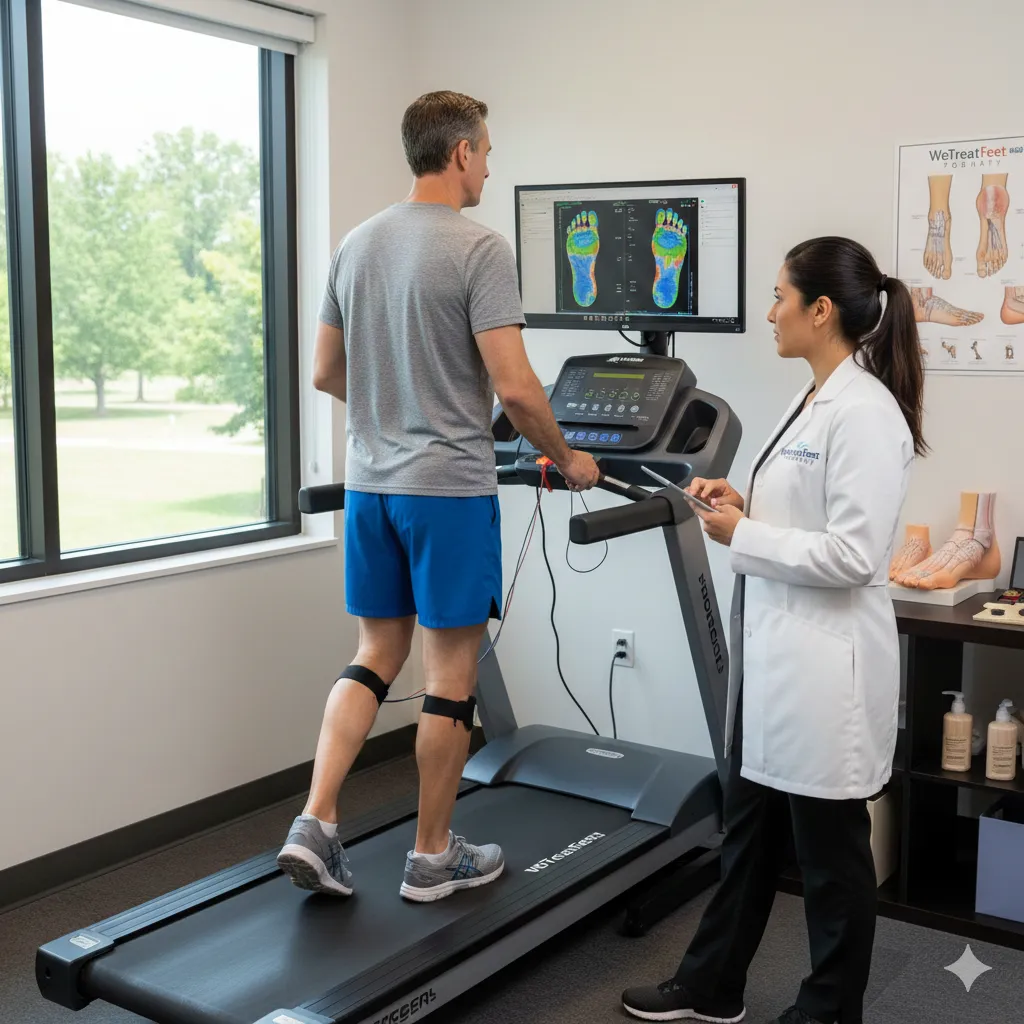
Our Recommended Treadmill


Simple treadmill walking form guide
Here’s how I coach form, especially for patients who are nervous about balance or foot pain:
Start with standing tall with good posture, eyes forward, not staring down at your feet, and keep the weight centered over the hips. This helps to ease any low-back strain. Don’t forget the arm position. Patients are told to keep a light bend at the elbows with hands relaxed like holding a small paper cup. Safety also needs to be considered so hold the rails and use them lightly with just fingertip contact. Do not place the entire body weight onto them.
When starting to walk, take short to medium strides, avoiding no big lunges. Focus on landing the feet under your body rather than way out ahead. This reduces strain and protects your knees and hips while boosting balance. Focus on a controlled heel-to-midfoot strike, then roll through and push off the toes. Avoid heavy heel stomping or staying up on your toes the whole time, as this can irritate joints or tighten up those calves over repeated.
Don’t forget to breathe. In through the nose, out through the mouth.
Lastly, avoid the drift forward on the belt or “chasing the console”. If the toes get too close to that front plastic, just step back an inch or two, and your posture snaps right into place.
Is treadmill walking as good as walking outdoors?
From a pure heart‑health and calorie standpoint, treadmill walking at the same speed and incline is essentially the same as walking outside. I have read studies show that energy use and joint loading at similar speeds are very comparable. With other metrics like cardiovascular fitness, blood sugar control, and weight management, a 30‑minute brisk treadmill walk “counts” just as much as a 30‑minute outdoor walk at the same effort. The difference is in stress injuries. Treadmill is the same force over and over again in an identical fashion. Outdoors, there are changes in terrain, the crown of the surface, and height. This means less repetitive stress on each part, but more opportunities for injuring other structures. However outdoors gets light exposure, a known mood boost and there is evidence that suggests green spaces and natural environments support mental health and reduce stress.
On the flip side, as a podiatrist, there are people for whom the treadmill is clearly the better starter option:
- Those with neuropathy who can’t reliably feel the ground.
- Patients with a history of ankle sprains or poor balance.
- Folks recovering from surgery who need predictable footing and easy access to a handrail.
In these cases, the smooth belt, climate control, and the ability to stop instantly make treadmill walking safer and more sustainable.
So, is it “as good”?
For most health metrics, if you match time and intensity, it is the same. If the goal is variety or scenery, balance, and the mental side of movement, outdoors wins. In my own practice, the advice is simple, just use whichever one the patient will actually do 4–5 days a week. Never forget to protect your feet while you do it, and sprinkle in outdoors when life and weather allow.

WeTreatFeet Podiatry 410-363-4343
Frequently Asked Questions: Treadmill Walking & Foot Health
1. Is treadmill walking better for your feet than walking outdoors?
From a cardiovascular and calorie-burning standpoint, treadmill walking and outdoor walking are essentially equal. However, as podiatrists, we often recommend the treadmill as a safer starter option for specific patients.
A treadmill provides a predictable, level surface and handrails, which is critical for:
- Neuropathy patients who cannot reliably feel the ground.
- Post-surgical recovery where predictable footing is required.
- Balance issues or a history of frequent ankle sprains.
While outdoor walking offers terrain variety that reduces repetitive stress and boosts mental health, the treadmill is often the superior choice for controlled, sustainable rehabilitation.
2. What is the best 30-minute treadmill routine for joint health?
At WeTreatFeet, we provide a joint-friendly 30-minute protocol that focuses on gradual progression:
- Warm-up (0–5 min): 2.0–3.0 mph at 0% incline. Focus on relaxing your shoulders.
- Steady Block (5–15 min): 3.0–3.8 mph at 1% incline. You should feel your glutes working but experience no sharp pain.
- Gentle Intervals (15–25 min): Maintain speed but vary incline (0% to 3%) to “wake up” different muscle groups without high impact.
- Cool-down (25–30 min): Return to 2.0 mph and 0% incline. Check your feet for “hot spots” or numbness.
3. How can I improve my walking form to avoid foot and ankle pain?
Proper gait retraining can significantly reduce “braking forces” on your knees and hips. We coach our patients on the Heel-to-Toe Method:
- Land Softly: Your heel should touch first.
- Roll Through: Move the weight through the arch/midfoot.
- Push Off: Finish the step by pushing off the big toe (hallux).
- Shorten Your Stride: Ensure your foot lands under your hips rather than way out in front. This prevents the “slapping” sound that indicates over-striding.
4. When should I stop exercising and call my podiatrist?
Pain is your body’s way of telling you to stop. You should cease treadmill exercise and contact WeTreatFeet Podiatry or your Primary Care Physician if you experience:
- Sharp, pinching pain in the front of the ankle.
- Tingling, burning, or numbness in the feet or calves.
- “Hot spots” or skin rubbing that could lead to blisters (especially for diabetic patients).
- Persistent calf soreness caused by sudden jumps in treadmill incline.
5. Can I use the treadmill if I have foot neuropathy or balance issues?
Yes, but safety is the priority. If you have neuropathy, diabetes, or balance concerns, start at the lower end of speed ranges (2.0 mph) and use the handrails for light stability (fingertip contact only). Avoid “chasing the console”—if you drift too far forward, step back an inch to reset your posture and keep your weight centered over your hips.
6. Should I stretch after treadmill walking?
Absolutely. If you have a history of plantar fasciitis or forefoot pain, we recommend finishing every session with calf stretches and gentle towel curls with your toes to maintain flexibility and foot strength.
Foot or ankle pain?
Our team is here to help — book a visit at any of our 13 locations.